Showing posts with label Mitre. Show all posts

December 13, 2013

Chilean Mitre

 This mitre carries symbols of the native peoples of Chile:
 
© picture: Wikimedia
 
It was made by the hands of Chilean craftsmen and is used during the great celebrations of the Diocese of Chile


Cruz Andina
Andine Cross, originating from the culture of the Andes, is the most common and it symbolizes the eternity of these cultures. Generally it is a symbol used by the "lonko" or chief of a native Latin America people.
 
 
 Cruz simétrica
The symmetric cross of equal arms is a complex symbol, representing the sky, the rain and live. It is also a cosmological symbol or a representation of the world.


Diaguitas pattern

November 21, 2012

Mitre Worn by Bishops of the Syro-Malabar Catholic Church

Major archbishop of Syro-Malabar Catholic Church
and the archbishop of Ernakulam-Angamali

Mitre with dove (representing the Holy Ghost)
and on the top of the mitre:
Kurishu or Nasrani Menorah cross of the Knanaya

September 15, 2012

Headgear of Monsignore Angelo Amodeo

In memoriam of Msgr. Angelo Amodeo, Canon of the Milan Cathedral,
who passed away on 14th September 2012


Msgr. Angelo Amodeo, Canon of the Milan Cathedral, with black biretta made out of black watered silk, 3 horns (blades, wings) and red-purple pompon 

© picture: Orbis Catholicus
Msgr. Angelo Amodeo wearing a pileolus (zucchetto, soli deo) with red purple sticking and stem

© picture: Orbis Catholicus
Msgr. Angelo Amodeo with mitre auriphrygiata (golden mitre)

Thanks to John Sonnen of Orbis Catholics for all these wonderful pictures.

August 22, 2012

Head Coverings of the Old Roman Catholic Church Latin Rite

Ecclesia Veteris Catholica Romana


H.E. The Mt Revd Jerome Lloyd OSJV, Metropolitan Archbishop of Europe with Spanish Bonete in red purple with red pompon

 
H.E. The Mt Revd Jerome Lloyd OSJV, Metropolitan Archbishop of Europe wearing a mitre

H.E. The Mt Revd Jerome Lloyd OSJV, Metropolitan Archbishop of Europe with zucchetto (pileolus, soli deo)

November 03, 2011

Three Protestant Mitres

Have a look at the following 3 mitres which were used in the Protestant Kloster Loccum.

Mitre of th 18th century

Mitre used around 1900 ornamented with Luther roses

Mitre of 1963 (800 years Kloster Loccum)
worn stilltoday by the abbot of the abbey


Horst Hirschler, Abbot of Kloster Loccum

May 06, 2011

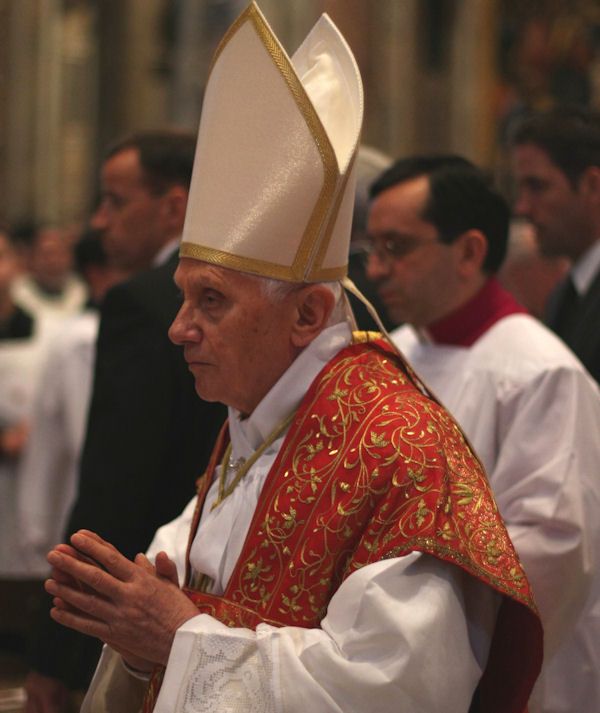
The White Papal Mitre

This kind of mitre is (strictly speaking)  only worn by the Pope when he died.

The body of Pope John Paul II lying in state wearing a white mitre made of Lame fabric (white silk with silver threads) and a gold embroidered band. The lining is iviory silk.

The body of Pope John Paul I lying in state.


Picture of the white papal mitre

From "Ettore Bianchi: Dizionario Internazionale dei Tessuti "
(Editore: Tessile di Como, 11/1999, 624 pages):

Lama (it. fr.)
lamato, laminato, tutta lama — it.
lamè — fr.
tissu de soie tout lame — fr.
llama — in. sp.
silk stoff shot with gold and silver — in.
ganzreicher Stoff — ted.
Lama — ted.
tejido de seda brocado totalmente — sp.

1.
Tessuto rigido e brillante, generalmente di seta e cordonato, con una trama di seta alternata a una laminetta di oro fino o di argento fino, qualche tipo di lama era anche fatto con lama e filo oro o argento.
Da lama = laminato.

2.
Tessuto, simile alla flanella, ottenuto con lana di lama con armatura o batavia o liscia o a spina o operata, accotonata al diritto e poco cimata. L'animale che fornisce questo pelo è un camelide (lama glama) dalle proporzioni di un cervo, con pelame soffice, lungo e lanoso, che vive dalle Ande cilene sino alla Terra del Fuoco in un habitat naturale sopra i 4000 m. Questo pelo può essere di quattro colori: bianco, marrone bruciato, grigio e nero. All'esterno il pelo è folto e ordinario, mentre il sottopelo è lucido e con grandi proprietà termiche. Il suo peso standard oscilla tra 300 e 450 g/mq. Si usa questa stoffa specialmente per confezionare giacche. Il tessuto è leggero, brillante, ma non morbidissimo. In genere vengono filate le fibre dei lama giovani entro il primo anno di vita.
Dal quetchua llama passato tale quale nello spagnolo e quindi nell'inglese.

3.
Tessuto operato broccato in cui la trama è - in tutto o in gran parte - di oro fino o argento fino.


Pope Benedict XVI during Good Friday 2011

January 31, 2011

The Mitre of the Papal Coat of Arms

On the coat of arms of His Holiness Pope Benedict XVI. the tiara was replaced by a mitre with 3 stripes.

About the mitre in the coat of arms (Source: Coat of Arms of His Holiness Benedict VI.):

"The Supreme Pontiff's arms have featured a "tiara" since ancient times. At the beginning this was a sort of closed "tocque". In 1130 a crown was added, symbol of the Church's sovereignty over the States.
Boniface VIII, in 1301, added a second crown, at the time of the confrontation with Philip the Fair, King of France, to show that his spiritual authority was superior to any civic authority.

It was Benedict XII in 1342 who added a third crown to symbolize the Pope's moral authority over all secular monarchs, and reaffirmed the possession of Avignon.

With time, although it lost its temporal meaning, the silver tiara with three gold crowns came to represent the three powers of the Supreme Pontiff: Sacred Orders, Jurisdiction and Magisterium.

In past centuries, Popes wore the tiara at solemn official celebrations and especially on the day of the "coronation" at the beginning of their Pontificate. Paul VI used for this purpose a precious tiara which the Archdiocese of Milan had presented to him, just as it had given one to Pius XI; but afterwards, Paul VI donated it to a charity and introduced the current use of a simple "mitre", although these mitres were sometimes embellished with ornaments or gems. But he left the "tiara" and the crossed keys as the emblem of the Apostolic See.

Today, the ceremony that begins a Pontificate is no longer called a "coronation". The Pope's full jurisdiction begins the moment he accepts his election by the Cardinals in the Conclave and not with coronation as for secular monarchs. This ceremony, therefore, is simply called the solemn inauguration of his Petrine Ministry, as it was for Benedict XVI on 24 April.

The Holy Father Benedict XVI decided not to include the tiara in his official personal coat of arms. He replaced it with a simple mitre which is not, therefore, surmounted by a small globe and cross as was the tiara.

The Papal mitre shown in his arms, to recall the symbolism of the tiara, is silver and bears three bands of gold (the three powers: Orders, Jurisdiction and Magisterium), joined at the centre to show their unity in the same person."

After my knowledge, at this time there exists only one real mitre made exactly according to the mitre of the coat of arms of
H.H. Pope Benedict XVI.:


You can read some critical comments from the point of correct heraldry about the mitre used in the new coat of arms of the Holy Father from Mr Maurizio Bettoja, member of the Società Italiana di Studi Araldici (S.I.S.A.) (unfortunately only in Italian language):

Lo stemma di Benedetto XVI di Maurizio Bettoja

Uno stemma assurdo di Maurizio Bettoja

In the above articles the mitre is described as "mitria zebrata" (for the mitre is looking similar to the tripes on the skin of a zebra).

In his letter to the editor of the German newspaper Die Tagespost dated 24th of May 2005, page 16, Mr Stephan Uano discribes this mitre as "Mitriara" (new creation of the words "mitre" and "tiara").

December 20, 2010

What a Mitre Auriphrygiata looks like


© pictures: Orbis Catholicus, 10th of April 2011
 H.E. Raymond Leo Cardinal Burke
Pontifical Mass sung at Lenten Stational Church of San Nicola in Carcere with outdoor penitential procession and chanting of the Litany of Saints.


For more information on the mitre, start your expedition here.
Related Posts Plugin for WordPress, Blogger...